
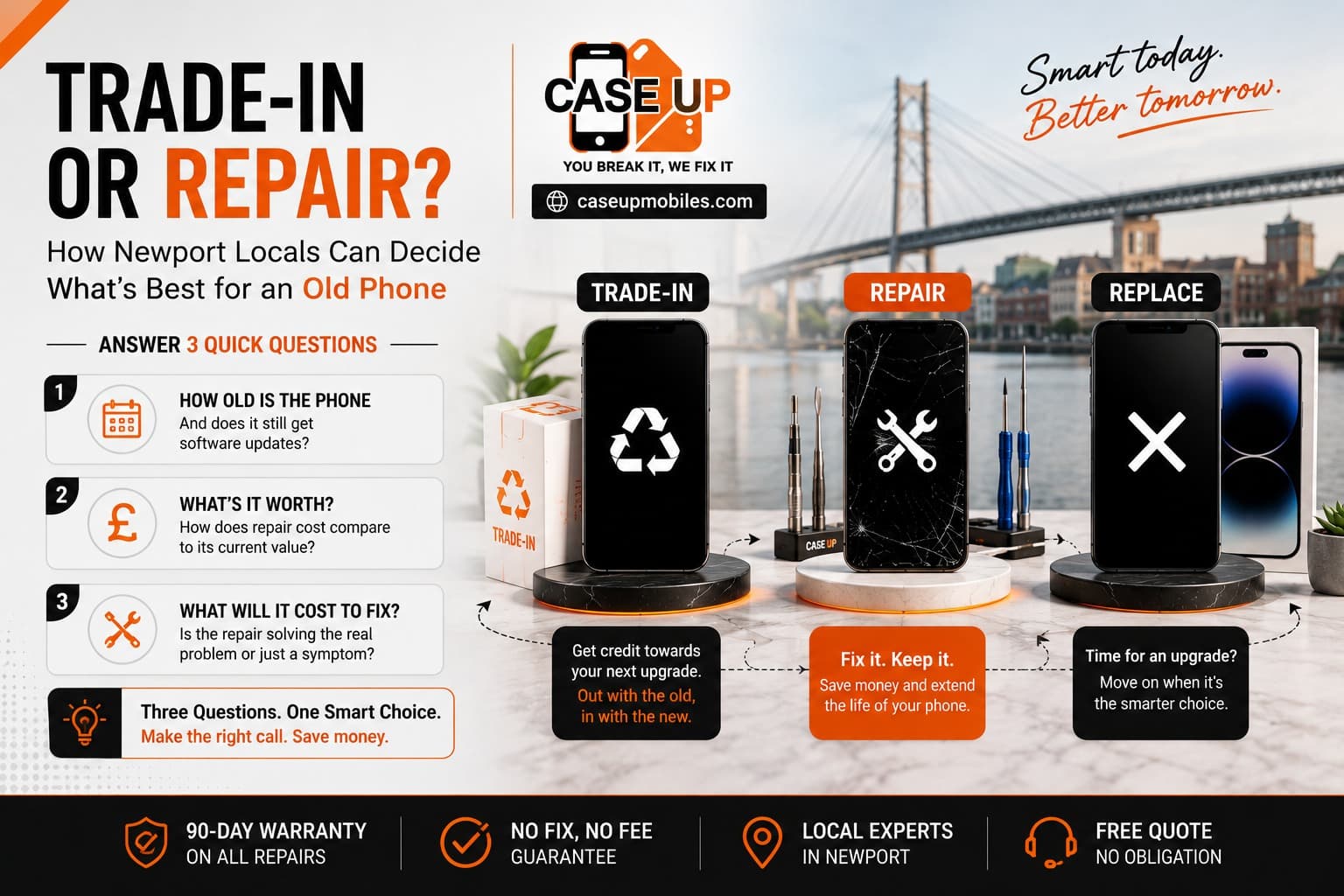
There is a phone in a drawer in almost every Newport house. Usually a couple of them. The battery is tired, the screen has a crack you have learned to ignore, and every so often you think about upgrading. Then you look at the price of a new flagship and change your mind.
At that point people usually take one of three routes. They stick with the phone as it is, they trade it in against something new, or they repair it and keep going. All three are legitimate. What is not legitimate is being sold on one of those routes by someone with a financial interest in that answer.
This guide is the framework we use when Newport locals bring in old devices and ask, in effect, "what should I do." We do not always tell people to repair. Sometimes the honest answer is trade in and move on. What matters is that the decision is based on three real questions, not on how you feel about your phone in the moment.
Read through those three questions with your device in mind. By the end you will have a clear answer, and probably you will have saved yourself money, whichever route you take.
The average UK adult upgrades their phone every 32 months, according to broad industry survey data. That is much slower than a few years ago, which is a good thing for wallets and for the environment. Phones now hold up longer, get software updates for longer, and are easier to keep going with the right maintenance.
The decision to repair or trade in is essentially a decision about the next 12 to 24 months of your device life. Get it right and you save several hundred pounds. Get it wrong and you pay twice: once for the wrong fix, and again for the upgrade you should have gone straight to.
Three questions, in order. Do not skip ahead.
Question 1: How Old Is the Phone, and Does It Still Get Software Updates?
Software support is the single most under-considered factor in the trade-in versus repair decision. A phone that no longer receives security updates is a phone that is quietly becoming a liability, regardless of how good the screen and battery look.
Every phone manufacturer publishes a support window. Once the phone is outside that window, security patches stop arriving. New apps eventually stop supporting the older OS version. Banking apps in particular start refusing to run on outdated systems, because they will not accept the security risk.
An out-of-support phone is not immediately broken. It will still make calls, still send messages, still browse the web. But every month that passes, more things break: an app updates and no longer runs, a banking app rejects the OS, a security vulnerability becomes exploitable.
Repairing a phone that has already fallen outside its support window is usually money badly spent. You are investing in a device that is on borrowed time.
Apple runs the longest support windows in the industry. As a rough working rule for Newport locals looking at their iPhone in 2026:
- iPhones from the last five years: fully supported, safe to repair and keep for years to come
- iPhones from six to seven years ago: on the edge, still receive some updates but check the latest iOS compatibility list
- iPhones older than seven years: increasingly likely to be dropped in the next major iOS release
If your iPhone is still in the first bracket, the repair route is almost always the better economics. Screen and battery replacements on a supported iPhone extend the useful life by another two or three years easily.
Android is more varied. Samsung Galaxy S and Note flagships from 2021 onward receive five to seven years of security updates. Google Pixel devices from Pixel 6 onward receive seven years of support. Budget Android phones typically get two to three years of security updates and are effectively out-of-support within four years of launch.
For a Samsung Galaxy from 2021 or later, or any Pixel 6 or newer, the repair route is on the table. For a budget Android phone from four or more years ago, trade-in and replace is often the smarter path.
Our full breakdown of common Samsung screen repair scenarios in the cracked Samsung Galaxy screen repair cost guide for Newport covers exactly which Galaxy models are worth repairing today and which are not.
Question 2: What's It Worth, and What Will It Cost to Fix?
This is the maths question. It has a rough working rule, and it has exceptions.
The industry rule of thumb is: if the repair cost is more than 50% of the current market value of the phone, replace it. If it is less, repair it.
The rule holds for most cases. Where it breaks down:
- When you have already invested emotionally in the device. People overvalue phones they have owned for years, and undervalue newer replacements. Try to remove that bias.
- When the fault is masking a bigger problem. A cracked screen is a £45 fix if the underlying display works. If the LCD is bleeding, it is a £150 fix. Diagnose before you decide.
- When the phone is out of software support. In that case, even a cheap repair is a bad investment, because the phone will be functionally obsolete within a year or two.
- When the repair addresses a symptom, not the underlying degradation. A screen swap on a five-year-old phone with a tired battery, worn charging port, and drifting Wi-Fi radio just delays the inevitable.
To make the 50% rule useful, you need honest local repair pricing. Here is what a Newport local should expect at a properly run repair shop like Case Up Mobiles, starting prices for common jobs:
- iPhone screen repair from £25 depending on model
- Samsung Galaxy screen repair from £45 depending on model
- Google Pixel screen repair from £99 depending on model
- iPad screen repair from £45 depending on model
- Battery replacement typically £45 to £90 depending on model
- Charging port repair typically £45 to £75 depending on model
- Water damage recovery diagnostic quoted case-by-case
For a comprehensive breakdown of screen repair pricing across all major brands, our Newport phone screen repair cost guide for 2026 sets out exactly what to expect for each model tier.
The resale value of a used phone in 2026 depends on model, condition, storage, and how long since release. A working iPhone from three years ago in decent condition retains meaningful resale value. A working Samsung Galaxy S from five years ago retains far less. A budget Android from four years ago is often worth £30 to £70 on the secondary market, regardless of condition.
Cracked screens depress resale value dramatically. A phone worth £250 working can drop to £80 with a broken screen. That is the reason the "fix it then trade it in" middle path (below) often wins.
If your battery is the underlying issue, our post on iPhone battery draining fast and the signs it needs replacement covers the exact symptoms that determine whether a battery replacement will genuinely revive the phone or just delay the trade-in decision.
Question 3: Do You Still Like the Phone?
This is the emotional question, and the honest one. The other two are maths. This one is you.
Some people love their phone. It fits their hand, they know every gesture, the camera captures their kids the way they want. That is a real attachment, and it justifies keeping a phone longer.
Some people feel guilty about the idea of upgrading because they think their phone still "works fine." That is a different feeling. If you have been thinking about a new phone for months, the honest answer might be that you are ready to move on, and pouring money into repairing the old one is a way of postponing the decision.
Ask yourself plainly. If the phone were replaced for you today by a fairy godmother, would you be relieved or disappointed? That answer tells you where you actually stand.
Beyond the emotional side, look at how you actually use the phone. If you are charging twice a day, or carrying a portable battery pack everywhere, the phone is not serving you. A battery replacement can transform daily use.
If you are avoiding certain apps because they crash, or you have stopped taking photos because the storage is full, or you find yourself annoyed with the phone more often than not, those are all signs of a device that is holding you back.
Here is the option most people never consider: repair the phone to restore its resale value, then trade it in.
The Middle Path: Repair It, Then Trade It In
The maths often works out surprisingly well. A cracked-screen iPhone might sell for £150 as-is. Repaired, the same phone sells for £320 on the secondary market. If the screen repair cost you £70, you have netted £100 by fixing before selling.
This works especially well for popular models with strong resale demand. It works less well for budget or older models where even a fixed phone has limited resale.
At Case Up Mobiles we handle both sides of this. We repair to restore condition, and we buy, sell, and part-exchange devices at fair value. If you are considering this middle path, our full services overview covers what is on offer.
Protect Your Data Before You Trade In
Whichever route you choose, your data is the invisible factor.
If you repair, your data stays on your device throughout, with almost no risk.
If you trade in or sell, you need to back up everything, then factory reset the device, then confirm the reset before it leaves your hands. If you skip any of those steps, you are handing over personal photos, saved passwords, banking app sessions, and messages.
Before you sell or trade in any device:
1. Back up to iCloud (iPhone) or Google account (Android) and confirm the backup completed
2. Sign out of iCloud, Apple ID, Google account, Samsung account, and any other cloud services
3. Factory reset the device fully
4. Verify the reset by trying to power the phone on and seeing the "welcome" setup screen
5. Remove the SIM and any memory card
Any reputable buyback service will insist on these steps. If a buyer or trade-in scheme does not, that is a red flag.
There are four main routes. Each has a different balance of convenience, price, and hassle.
Your Four Trade-In and Selling Options
You post the phone to a specialist buyer, they inspect it, they pay you. Convenient but usually the lowest offer. Beware of "downgrading" after inspection, where the offer drops between the quote and the payment.
You bring the phone to your mobile carrier when upgrading your contract. The trade-in value comes off the price of the new phone. Convenient if you are upgrading anyway, but the value is often locked into the new contract deal and hard to compare cleanly.
Marketplace listings, eBay, Facebook Marketplace, or a local buy-sell group. Highest potential price, most hassle. You handle listing, meeting buyers, and the risk of chargebacks or disputes. Not for everyone.
Bring the phone into a local shop for a face-to-face valuation. You get an immediate offer, cash or bank transfer on the spot, and the shop handles the data wipe and onward sale. Usually the most balanced option: price is competitive, the process is fast, and you deal with a real person you can go back to.
Case Up Mobiles offers buy, sell, and part-exchange as one of our core services. Bring your device to 39 Commercial Street for an honest valuation.
Whichever way you lean, a proper repair quote from a Newport shop should include:
What a Proper Repair Quote Should Include
- Free diagnostic first, no obligation
- Fitted price, not just parts
- The grade of part being used (OEM equivalent, aftermarket, refurbished)
- Warranty on parts and labour, minimum 90 days
- Turnaround estimate (same-day for most common jobs)
- Clear no-fix, no-fee policy if the diagnostic determines the repair is not economical
If a quote arrives without those pieces, ask for them. A shop that is not transparent about part grade or warranty is a shop to avoid.
The full context of what proper repair transparency looks like in Newport is covered on our why Newport locals choose Case Up Mobiles for repair page.
When We Recommend Trading In Instead of Repairing
We turn down repairs regularly. Here are the situations where we tell customers the honest answer is trade in and move on.
- The phone is more than five years old and out of software support. Any repair is a short-term investment on a phone that will be obsolete within a year.
- The fault is one of several. Cracked screen plus tired battery plus wobbly charging port plus dodgy Wi-Fi radio is a device telling you it is time.
- The repair cost exceeds resale value plus a significant margin. If a screen swap costs £150 and the phone sells for £120 fixed, the maths does not work.
- The phone was water damaged months ago and has been intermittently misbehaving. Corrosion is progressive. A quick fix today does not stop the ongoing damage inside.
- A newer version of the same phone is a modest upgrade. If your iPhone 12 is broken and an iPhone 14 is within reach at part-exchange value, sometimes the upgrade path is the cleaner one.
Honest advice is a competitive advantage in a market where most shops just want the repair job. It also means when we do say "repair it," you can trust the answer.
Three Real-World Decision Examples
Sarah's Supported iPhone With a Cracked Screen and Tired Battery
- Phone still supported by current iOS
- Screen repair: around £50
- Battery replacement: around £45
- Combined repair cost: under £100
- Resale value fixed: around £200
Answer: repair it. Sarah gets a phone that will comfortably last another two years for less than £100. Straightforward decision.
An Older Samsung With Several Limitations
- Phone is seven years old, well out of Samsung security update window
- Charging port repair: around £45
- Slow performance is likely a combination of old SoC and app bloat, not fixable
- Resale value: around £30 as-is
Answer: trade in and move on. Even a £45 charging port fix cannot revive a phone that is functionally at the end of its life.
Priya's Supported iPhone With Strong Resale Value
- Phone is fully supported
- Priya is considering an iPhone 16 anyway
- Combined repair cost: around £75
- Fixed resale value: around £300
- New iPhone 16 cost after trade-in: significant reduction
Answer: the middle path. Repair to restore condition, part-exchange, contribute the credit toward the upgrade. Priya gets a new phone at a lower net cost than trading in her broken one directly.
The pattern in these scenarios is not "repair always wins." It is that the right answer depends on all three questions together.
Frequently Asked Questions
How long should a smartphone actually last?
Most modern phones last five to seven years hardware-wise, but software support runs out first. Aim to keep your phone until either it becomes hardware-unreliable or it falls out of security updates, whichever comes sooner. For iPhones that is often seven or more years. For Android it varies from three to seven depending on manufacturer.
Is a battery replacement worth doing on an old phone?
If the phone is still in software support and the battery is the primary limitation on daily use, yes. A battery replacement often adds two years of comfortable use for less than £100. If the phone is out of support or has multiple faults, no.
Will repairing a phone affect its resale value?
A repair done with correct-grade parts, with a warranty from a reputable shop, does not depress resale value. A repair with obviously aftermarket parts, or a repair on a phone that already has hidden water damage, does. Use a shop that documents the repair and honours the warranty.
Should I sell privately or trade in locally?
Selling privately gets a higher headline price but takes time and carries risk. A local trade-in at a Newport shop is faster, safer, and often close enough in value that the convenience is worth it. Get quotes both ways before deciding.
What if my phone will not turn on at all?
A phone that will not power on has a range of possible causes, from a dead battery to a board-level fault. A free diagnostic gives you a clear answer. Do not assume it is dead until a proper diagnosis has been done. If water was involved at any point, our water damage repair guide for Newport covers exactly what recovery involves.
Get an Honest Repair or Trade-In Assessment in Newport
If you are staring at an old phone and unsure which of the three routes fits, walk into Case Up Mobiles at 39 Commercial Street. We will run through the three questions with you, give you a free diagnostic on the device, and quote the repair honestly. If the honest answer is trade in, we will tell you that too, and give you a fair part-exchange offer on the spot.
Whether you have an iPhone that needs looking at or a Samsung Galaxy that has seen better days, the answer starts with an honest diagnostic.
Free quote, no fix no fee, and 90-day warranty on every repair. Book your free assessment in Newport here.